Content Licensing
Choose the content and programs you need for your own education business. We agree with each partner on what can be used, how it can be used and the support provided.
The 1000 series develops vocabulary recall through images and sentences; the 2000 series adds word relationships, parts of speech and word forms for accurate speech and writing.
VOCAPEDIA connects vocabulary encountered in stories and nonfiction with images, sentences and meaning, developing recall for speech and writing. In the 1000 series, learners recall familiar sentences and clarify the meanings and uses of 1,000 words. The 2000 series adds 1,000 new words toward a cumulative target of 2,000, deepening understanding of related words, parts of speech and word forms so learners can choose and use vocabulary appropriately.
The 1000 series draws vocabulary from FluenTree and PYP1; the 2000 series draws from ConnecTree and PYP2. Vocabulary study returns to the stories and topics learners have read and understood, reconnecting words with the scenes and ideas they express.
Everyday vocabulary from stories is studied alongside academic vocabulary from nonfiction. Words for describing actions and situations, and for understanding and explaining knowledge, are learned in sentences and connected with reading, thematic learning, speech and writing.
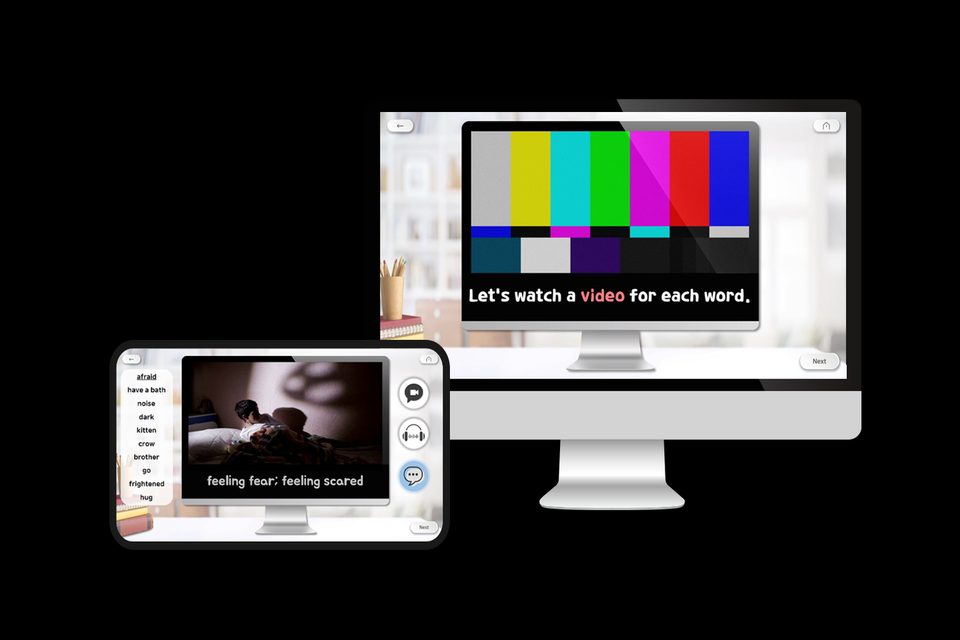
After understanding and learning vocabulary and sentences in FluenTree and PYP1, children use images as cues to recall and say related sentences. The image prompts memory, while the sentence provides context for understanding the target word’s meaning and use.
Children connect a pictured scene with its expression and retrieve the English that describes it. Recalling familiar expressions becomes a way to review vocabulary and practice using words within sentences.
After saying a sentence from an image cue, children check and clarify what the target word means in that context. If an expression is difficult to recall or inaccurate, they revisit its sound and meaning before trying again, practicing reliable retrieval of understood content.
Teachers consider both recall of the sentence and understanding of the vocabulary within it. Use in familiar sentences and appropriate selection in new speaking and writing situations are considered separately as learners broaden their use of words.
The 2000 series adds 1,000 new words to the earlier 1,000, with a cumulative learning target of 2,000 words. Language from ConnecTree stories and PYP2 nonfiction extends both the range of vocabulary and the depth of understanding.
Children examine definitions and parts of speech, along with relationships such as synonyms and antonyms. They connect the concept a word represents with its role in a sentence and consider which word and form suit the intended meaning.
Learners build a personal dictionary by selecting vocabulary from word lists, recording definitions and related words, and using selected words in their own sentences. Looking up, organizing and expressing meanings encourages closer examination of each word.
Activities include choosing suitable word forms for sentences from the reading text, arranging words to complete sentences and describing pictures with given vocabulary. Children check both the intended meaning of their word choice and its form within the sentence, connecting vocabulary understanding with accurate sentence use.
Book-linked online activities support individual exploration and practice of the meanings and uses studied in class. Learners continue vocabulary work introduced with teacher guidance, creating opportunities to check understanding and memory.
In the 2000 series, learners mark words they know before study and words they can write correctly afterward to review their learning. Progress is considered through the range of vocabulary remembered, independent recall of needed expressions, and use of meanings and word forms appropriate to context in speech and writing.
These are the ways this program can be used. Tell us your goals and we will discuss the configuration, scope of use and support.
Choose the content and programs you need for your own education business. We agree with each partner on what can be used, how it can be used and the support provided.
We discuss program options, support, territory and contract terms for each project and partnership.
From brand franchising and the supply and distribution of textbooks and content to international business, B2C sales and learning services. Tell us about the business you have in mind and we’ll recommend the best fit.